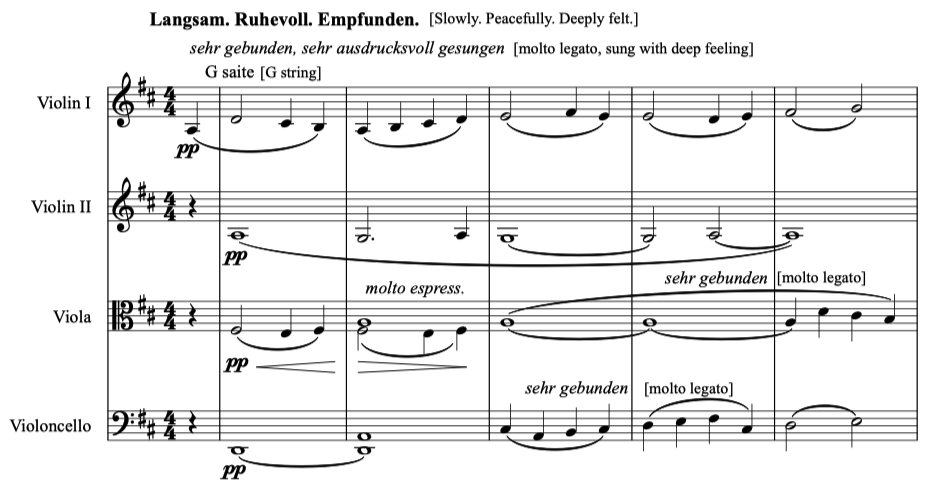
This is the longest and most complex of my three string quartets, variations on a theme from Mahler’s Third Symphony.
I take this theme through many changes, in many musical styles. Sometimes I stick close to its melody or harmony, or to both, and sometimes I treat it freely, just letting it inspire me, maybe quoting moments from it, or using things in its internal structure.
What emerges is a narrative — a journey in many episodes, whose meaning isn’t clear until the final chord.
Most of the variations are tributes to things I’ve loved, and what follows shows how that works.
I don’t explain variation 15, since without, having any special source, it’s simply a fugue, a standard classical music form.
And variation 17, the chorale prelude, is simple enough. I challenge myself to follow Bach in his chorale preludes, where he gave chorale melodies [hymn tunes of his time] accompaniments that work on their own as independent pieces. Could I do that with the Mahler theme? I could!
Now the theme and the rest of the variations — where they come from, and what I did with that.
Performance: a 1950 recording, with Hermann Scherchen conducting the Vienna Symphony.
In this excerpt you’ll hear more than the initial melody, which in the Mahler movement is the first part of something larger. I didn’t want to cut it off.
Plus, as the music continues, there’s some descending high counterpoint — breathtaking writing on Mahler’s part — which I borrow (or at least the idea of it) in my final variation, my unabashed tribute to Mahler.
Hear my final variation (from the Terra String Quartet recording):
Hear the theme, as it sounds in the quartet:
My variation quotes something in Beethoven, and then takes off in new directions from it.
What I’m quoting is one of his variation movements, the second movement of his Op. 111 piano sonata. I quote the third variation:
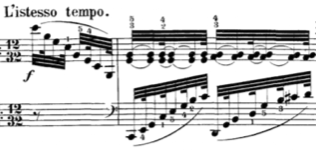
Here’s how it starts, in a joyful performance by Andras Schiff:
Hear my variation, taking off from Beethoven, but creating a variation on Mahler’s theme by using Mahler’s harmony:
From the album liner notes:
The Elvis variation…is a melody over a rock & roll beat, evoking some of the songs Elvis sang in the 1950s. It’s built on Mahler’s harmony, which has a longer chord progression than we’d find in any ‘50s rock song. My trick, then, was to make each phrase sound like something Elvis might have sung, even if the full variation doesn’t.
The Elvis song that most inspired me here was “I Was the One,” not one of his famous hits, but a song (a bit perverse) that I like a lot. It was the flip side of his first national hit, “Heartbreak Hotel.”
Hear my variation:
I quote the start of Mozart’s Piano Concerto No. 20 in D minor, K. 466.
Here it is, with Mitsuko Uchida conducting the Cleveland Orchestra (she plays on the recording, of course, but we don’t hear her in this brief excerpt):
Hear my variation:
This is a tiny sonata form movement, with the Mozart beginning as the first subject, and part of the Mahler theme as the second. In place of a development section, there’s a cadenza, and the second subject starts the recapitulation.
Rohmer is a French film director I’ve loved. I was thinking here of a scene in his 1984 film Les nuits de la pleine lune (“Nights with a Full Moon,” released in English-speaking countries as Full Moon in Paris). The film might be a bittersweet romantic comedy, or it might (since Rohmer knows the ambiguities of life) be an unhappy film with moments we smile at.
In the scene I took off from, a woman dances at a party while her unhappy boyfriend watches. They’re going to have a fight. I imitated the French pop song the woman dances to, using melodic notes from the Mahler theme, but in a rhythm suggested by the song.
I notice (listening again, as I’m making this page) that I stole the start of the song’s bridge.
The song, written for the film, is “Les Tarots,” by Elli et Jacno, an influential French synthesizer pop group, who created all the movie’s score.
Here I weave three echoes of Bach together. The propulsion of a Brandenburg concerto; the boychoir singing a chorale tune in the opening chorus of the St. Matthew Passion (this is where, in my variation, you hear the Mahler theme); and the intent solo playing in the cello suites.
I don’t need to quote a cello suite, or a fast movement from Brandenburg concerto. They’re well known. Here’s my version of them, from this variation:
Here, from the St. Matthew Passion, is the boychoir in the opening chorus. From the recording by Raphaël Pinchon, conducting his ensemble Pygmalion; the chorus is La maîtrise de Radio France, the choir from the Radio France choir school
Here’s my version of it (with cello interruptions)
And here you can hear the whole variation.
I wanted to quote the Schoenberg Fourth String Quartet, but didn’t have a score in our England retreat. So I rewrote bits of it from memory. Forgive me, world!
Here’s the start of the Schoenberg quartet, which I quoted.
Here’s another excerpt I used, and a third one (in both cases quoting or alluding to from memory).
The performance is the classic 1953 recording by the Juilliard Quartet, from which I learned the piece, many years ago.
The Terra performance sounds slow, next to the Juilliard. But in the flow of my piece, it’s perfect.
Here I was thinking of the first movement of Webern’s Symphony, Op. 21, one of my favorite pieces by any composer. Follow the link to hear it, with Pierre Boulez conducting the Berlin Philharmonic.
Here’s my variation, living (I hope) in the same sound world.
After a silence, this variation quotes, with two hesitations, from Variation 7 of the Goldbergs, starting with its second measure. Hesitations and silences are part of my piece, starting with my statement of the theme, which (unlike Mahler’s original) has a pause before its final cadence. Pauses continue intermittently in my piece, culminating in Variation 21, which is entirely silent.
Hear the part of the Goldbergs I quote (from Glenn Gould’s classic 1955 recording)
In my score, I call this opening section “Phantom Gigue.” After it comes a brief outburst, marked “Faster, in a furious rush,” which I call “Quick Toccata,” a reference to the many Goldberg variations that are toccatas, pieces showing off keyboard virtuosity.
Then, after a brief pause, comes a final section, called “Cadential Aria,” a reference to the lyrical aria that starts the Goldbergs, and that all of Bach’s variations refer to, by building on its harmony.
I don’t quote Bach’s aria, or refer to it in any way. But this section is a melodic line for the first violin, and it’s built (Goldberg-style, if you like) on the harmony of the last part of the Mahler theme, so there’s a Goldberg-like procedure going on in it. So, “Cadential Aria” — “aria,” because it’s a singing melodic line, and “cadential,” because the harmony is an elaboration of Mahler’s final cadence.
I love bel canto opera — and Bellini especially — almost to distraction.
But though this variation (at least to me) might have Bellini’s spirit in it, it doesn’t quote or allude to any of Bellini’s music. And it doesn’t in any strong way reflect what I think are the two main features of his style, extreme emotion and great physical verve.
If there’s any Bellini piece it reminds me of, it might be “Son vergin vezzosa,” a soprano aria from I Puritani.
Hear another piece of mine that reflects bel canto opera, a quintet from my opera Frankenstein (performed successfully in workshops, but still awaiting its professional premiere).
Here I had two scenes in mind, from Antonioni’s film 1961 La notte. Antonioni, slow-moving and difficult as he can be, has long been one of my artistic touchstones, for his powerful emotion, and fluid camera, revealing depths and nuances of feeling.
In the first of these scenes, Antonioni’s main character, a woman deeply disconnected from her life, has a rare happy moment, watching boys set off rockets. She tells her husband about it, on the phone from an outdoor cafe, while in the background a tune plays on the radio. I imitate that tune, with the first violin, in its own world, renders what the woman says on the phone.
See an excerpt from the score, showing the tune and the pizzicato
In the second scene, the woman walks on a street in Milan. The cliché, about the films that made Antonioni’s reputation, is that they’re about alienation. But here the alienation is more than a cliché. It’s tangible, with the city, above the woman, and all around her, looking like something that can’t be understood. This sequence, as it flows and changes, has the power of great visual art.
Hear the whole variation, with the music inspired by these film scenes
One summer, as I worked on this piece in a place my family goes in England, I heard a bird whose song was a falling minor third, the interval in music between D and B.
I built a variation from that. Though, speaking honestly, I don’t remember anymore how what I wrote is supposed to be a variation on the Mahler theme (except that its tonal center is D, the key the theme is in.
Still, though, it works as what’s needed in the moment when we hear it. The viola plays my version of the bird song, while the cello puts that in a quiet landscape:
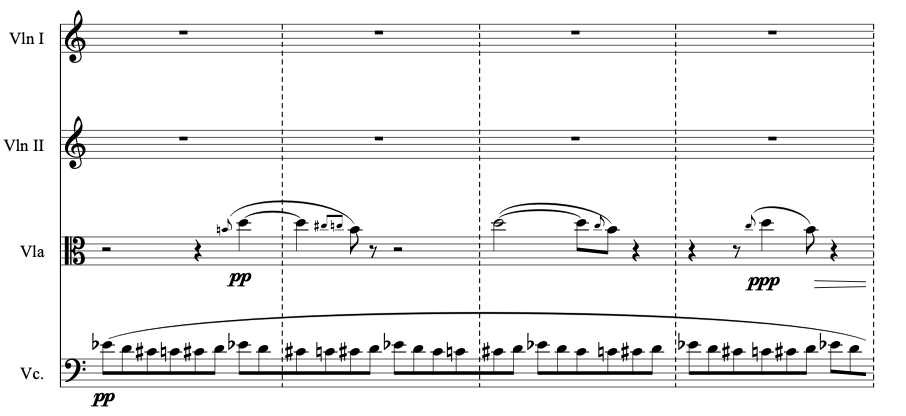
I’m in awe at how Chih-Ta Chen and Audrey Chen (the violist and cellist in the Terra String Quartet, who aren’t related) play this. Chih-Ta playing little wisps near the edge of silence, just as I imagined the music would sound. And Audrey so much present, but uninflected. Not everyone could do this!
We’ve had Schoenberg and Webern variations, and now, to complete a 12-tone trilogy, this one is a tribute to Berg. I quote a tune from his opera Lulu, literally a 12-tone melody — because it’s a tone row, using all 12 notes of the chromatic scale — and a very pretty one, even if you might not think 12-tone music can be pretty:

That’s how I quote it in the quartet, at the start of this variation.
Hear that (as rendered by my computer, not at all unmusically)
Hear it as it’s heard in the opera (in an interlude after the first scene of Act 1)
From a recording conducted by Karl Böhm, with with Orchester der Deutschen Opera Berlin. It’s an early recording of the opera, not played with the finesse of later ones, like those conducted by Christoph von Dohnányi and Pierre Boulez. But it has a 1930s-style brassiness I like.
Berg uses it both as I’ve quoted it, and inverted, or in other words turned upside down, a standard 12-tone procedure. Artificial as this might seem, or even mechanical, the inverted tune sounds just as pretty. This excerpt starts with the tune inverted; later we hear it as I quoted it.
Hear my variation, in which I play with the tune, using it, as Berg does, both as I’ve quoted it and inverted.
From the CD liner notes:
The Proust variation is the longest in the piece, and its quiet climax, written with the sound of Fauré songs in my mind, songs I sang early in my musical life, when I was a singer.
And the variation really is a song, a dreamlike setting of the first sentences of À la recherche du temps perdu (“In Search of Lost Time”), Marcel Proust’s long novel, one of the masterworks of 20th century literature, and maybe my favorite reading. My variation of course isn’t sung, but the musicians should play as if they were singing the words, which I’ve added to the score:
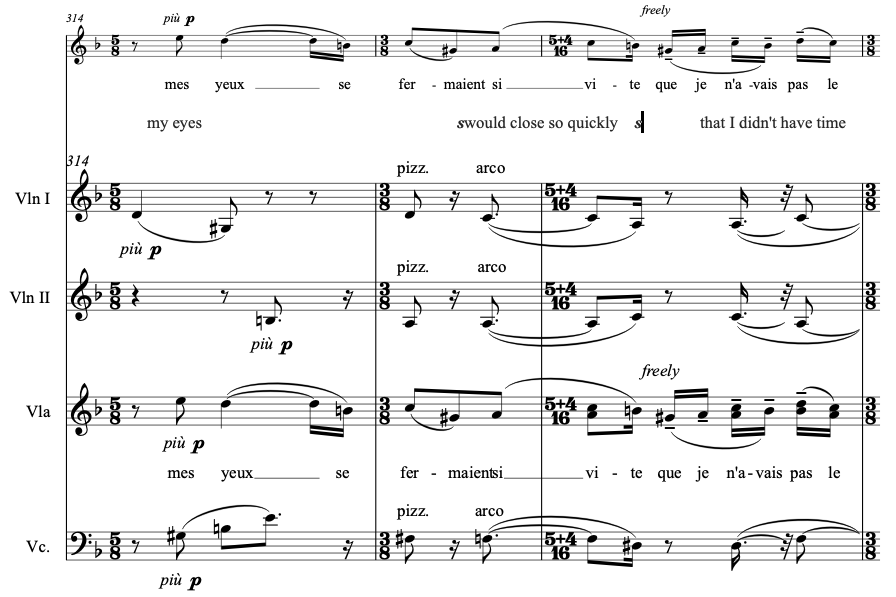
Here’s the full text, which I set to music in the original French. I’m giving it here in my own translation:
For a long time, I went to be early. Sometimes, with my candle barely out, my eyes would close so quickly that I didn’t have time to say to myself: “I’m asleep.” And, half an hour later, the thought that it was time to go to sleep would awaken me; I’d want to put down the book that I’d think I still held in my hands and blow out my light; even while asleep I hadn’t stopped thinking about what I’d just read. But these thoughts had taken a very particular turn; it seemed to me that I myself had become whatever the book was talking about: a church, a quartet [here in the music I quote the beginning of my own quartet, this piece], the rivalry of François the First and Charles the Fifth. This belief would persist for a few seconds after I awoke; it didn’t come as any kind of shock to my mind, but would weigh like scales on my eyes and would stop me from seeing that the candle was no longer lit. Then everything would begin to become unintelligible to me, just as after a reincarnation the thoughts of a previous life would; the subject of the book would detach itself from me, I’d be free to link it to myself or not; all at once I’d recover my sight and I’d be astonished to find darkness all around me, sweet and restful to my eyes, but perhaps even more for my mind, to which it seemed like something without any cause, incomprehensible, like something truly dark.
There’s a place in England we go to, deep in the countryside, a region of hills and valleys, called fells and dales by the people who live there. This is in the Yorkshire Dales National Park. The nearest city (not close) is Kendal, the nearest town is Sedbergh, the nearest village is Dent.
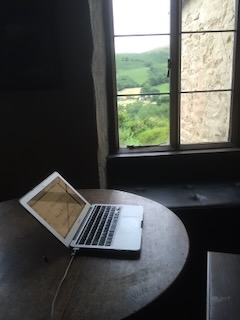
Sheep outnumber people. It was there I wrote much of Mahler Variations, sitting at a table by a window, through which I could see, across the dale we’re in, a fell with sheep that looked like little white dots.
Well, we can’t see the sheep in that photo. But I saw them, and in this variation translated the white dots into peaceful pizzicatos, randomly grouped in twos and threes (as the sheep were; ewes with one adolescent lamb, ewes with two).
Once I saw a tiny black dot — a sheepdog, herding the sheep in a rush downhill. That’s the rush that ends the variation.
John Cage is most famous for a silent piece, 4’33”, four minutes and 33 seconds in which performers (one or more; the number isn’t specified)) sit silently, and we hear only the sounds that naturally occur in the performance space.
Nt variation is a long silence, 22 measures of rests in the score. Though the precise count of rests doesn’t matter. What matters is the written instruction:
The exact length of this silence is up to the players. But it should last a minute or more. Resist all temptation to make it too short!
On the recording the silence is shorter, lasting just 20 seconds. A longer silence, we found, didn’t work, even recorded while the musicians sat quietly. In live performance, you can see the musicians. Their presence sustains the passing time, and they can feel when it’s right to move on, which will be different each time the piece is played.
On the recording, we found that the silence grew empty. Without the musicians, it lost any meaning. Twenty seconds, we found, was the optimum time, long enough to feel like a silence, but not so long that it died.
In this way, then, the recording departs from the score. But it makes its point to a listener, which counts for more.
Hear my John Cage variation, with the Sheep on the Hillside variation leading into it, and, from it, the Mahler variation emerging.
Watch a performance of Cage’s 4’33”
Performed by pianist Kyle Shaw on February 12, 2016, at the Foellinger Great Hall of Krannert Center for the Performing Arts at the University of Illinois Urbana-Champaign.
It’s important that, in Cage’s score, the piece is in three movements. Performers have to show the division into movements, by making some movement, or changing position. In this performance, Shaw opens and closes the piano lid, as pianist David Tudor did in the world premiere of the piece in 1952.
The division into movements makes a rigorous demand on the performer(s). How do you move to mark the three movements, without disturbing the silence?
I’ve performed 4’33” three times: with a group of middle school students, when I was teaching at a summer arts workshop; with the Pittsburgh Symphony, when I hosted a concert series with them; and in one of my classes, when I was teaching at Juilliard.
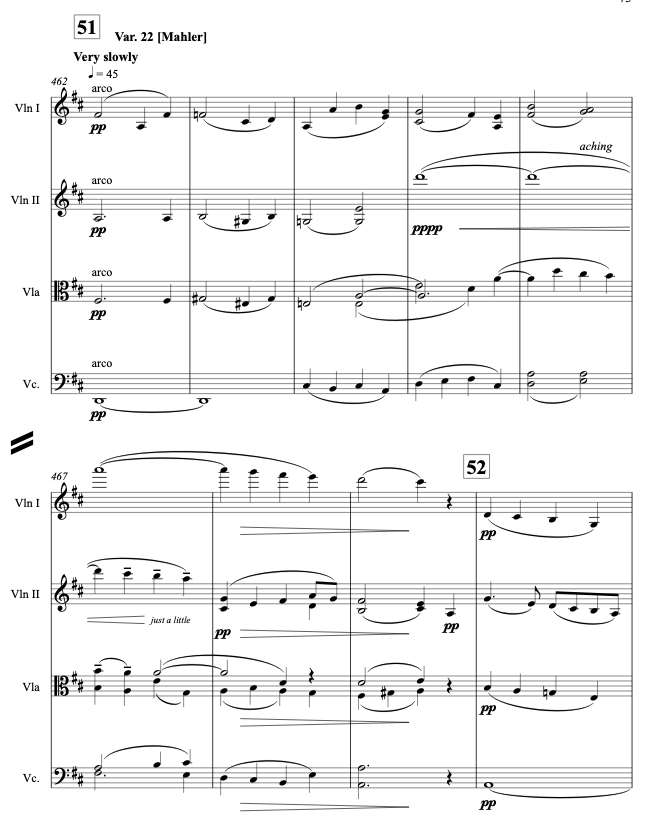
With this last variation, the quartet starts to end. I call it “Mahler,” because — after the journey of this piece, with so many tributes to so many things — I come back to the source of the music, Mahler himself.
I tried to write something in his style, but with no reference to any specific piece of his, and no quotes from him. There are some high descending lines in what I wrote, suggested by some he wrote, in the continuation of the Third Symphony melody I used as my theme, as the movement I took it from continues.
Listen to them in Mahler’s Third Symphony (from the Vienna Symphony recording conducted by Hermann Scherchen I used in the section here on the Mahler theme)
Here they are in my score, first in the second violin, where you see the dynamic marking pppp, and then in the first violin:
Some final thoughts.
My variation emerges from the John Cage silence, and dissolves into the coda of my piece. It dissolves by flowing into music from my Antonioni variation, a unison passage that, as it dissolves, loses the instruments, one by one, until there’s nothing left.
Letting parts of my piece recur is part of how I wrote it. The recurrences, like the Mahler variation turning into Antonioni — or silences through the piece recurring as John Cage — is one of the ways the music coheres.
My piece ends, after the Antonioni fadeout, with a short coda, starting with another reminiscence, a very brief one, just three notes, taken from the transition to the fugue in variation 15, the third note being a long-held high D in the first violin.
Over wisps in the other instruments, hints of past variations, the high D continues, and still sounds over the final chord, which it completes. With that final chord, D minor, the piece comes home, in a conclusion I didn’t expect, because, to my ear, it sounds so melancholy.
I wondered why it ends that way, and with the release of this recording, a reason occurred to me. This recording marks my emergence in the world as a fulltime composer, something I now know that I was always meant to be.
But I wasn’t, when I wrote this piece. And that must have made me sad.
This page is in progress…more is coming…